Why do they all use Microsoft AZ-204 exam materials?
Microsoft AZ-204 exam materials are the best solution for the “Developing Solutions for Microsoft Azure” certification exam, combined with actual scene verification, it is real and effective!
So they all use Microsoft AZ-204 exam materials to help themselves with exam practice! The latest Microsoft AZ-204 exam materials currently contain 576 exam questions and answers!
Download the Microsoft AZ-204 exam materials: https://www.leads4pass.com/az-204.html anytime to ensure instant validity!
Learning Catalog:
- Latest Microsoft AZ-204 Exam Details
- Latest Microsoft AZ-204 exam resources
- Conclusion
Latest Microsoft AZ-204 Exam Details
The exam name is “Microsoft Azure Development Solutions” and the exam code is AZ-204. The exam consists of 40-60 questions and the question types can be case studies, short answer, multiple choice, graded review, drag and drop, etc.
If you pass this certification exam, you may be eligible for ACE college credit. For more information, see ACE College Credit for Certification Exams. Additionally, this certification is part of the requirements for: Microsoft Certification: Azure Developer Associate.
| 1. | Exam Name | Developing Solutions for Microsoft Azure |
| 2. | Exam Code | AZ-204 |
| 3. | Time | 150 minutes |
| 4. | Exam Format | Reordering, Case Studies, Drag-and-drop, Command-line, and Multiple-choice |
| 5. | Exam Type | Cloud Computing |
| 6. | Number of Questions | 40-60 Questions |
| 7. | Eligibility/Pre-Requisite | NIL |
| 8. | Exam Fee | $165 USD* |
| 9. | Exam Language | English, Japanese, Chinese (Simplified), Korean, French, German, Spanish, Portuguese (Brazil), Russian, Chinese (Traditional), Italian, Indonesian (Indonesia), Arabic (Saudi Arabia) |
| 10. | Retirement Date | None |
| 11. | Passing score | 700/1000 |
| 12. | Update | 07/21/2025 |
| 13. | Validity period | This certification is valid for two years from the date of the issue. |
| 14. | Prerequisites | At least one to two years of experience working with Microsoft Azure is needed for programmers to sit for the AZ-204 exam |
[Oct 2025] Latest Microsoft AZ-204 Exam Questions
The AZ-204 exam is not easy. I believe many people have discussed the best solution: Books, community discussions, online training, etc. plus the most important practice test can ensure a 99% exam success rate!
| From | Number of exam questions | Format | Associated certification |
| leads4pass | 576Q&A | PDF + VCE | Microsoft Azure |
Question 1:
Your company has a web app named WebApp1.
You use the WebJobs SDK to design a triggered App Service background task that automatically invokes a function in the code every time new data is received in a queue.
You are preparing to configure the service processes a queue data item.
Which of the following is the service you should use?
A. Logic Apps
B. WebJobs
C. Flow
D. Functions
Correct Answer: B
Reference: https://docs.microsoft.com/en-us/azure/azure-functions/functions-compare-logic-apps-ms-flow-webjobs
Question 2:
Note: This question is part of a series of questions that present the same scenario. Each question in the series contains a unique solution that might meet the stated goals. Some question sets might have more than one correct solution, while
others might not have a correct solution.
After you answer a question in this section, you will NOT be able to return to it. As a result, these questions will not appear in the review screen.
You are developing a medical records document management website. The website is used to store scanned copies of patient intake forms.
If the stored intake forms are downloaded from storage by a third party, the contents of the forms must not be compromised.
You need to store the intake forms according to the requirements.
Solution:
1. Create an Azure Cosmos DB database with Storage Service Encryption enabled.
2. Store the intake forms in the Azure Cosmos DB database. Does the solution meet the goal?
A. Yes
B. No
Correct Answer: B
Instead use an Azure Key vault and public key encryption. Store the encrypted from in Azure Storage Blob storage.
Question 3:
Note: This question is part of a series of questions that present the same scenario. Each question in the series contains a unique solution that might meet the stated goals. Some question sets might have more than one correct solution, while
others might not have a correct solution.
After you answer a question in this section, you will NOT be able to return to it. As a result, these questions will not appear in the review screen.
You are developing an Azure Service application that processes queue data when it receives a message from a mobile application. Messages may not be sent to the service consistently.
You have the following requirements:
1.
Queue size must not grow larger than 80 gigabytes (GB).
2.
Use first-in-first-out (FIFO) ordering of messages.
3.
Minimize Azure costs.
You need to implement the messaging solution.
Solution: Use the .Net API to add a message to an Azure Service Bus Queue from the mobile application. Create an Azure Windows VM that is triggered from Azure Service Bus Queue.
Does the solution meet the goal?
A. Yes
B. No
Correct Answer: B
Don\’t use a VM, instead create an Azure Function App that uses an Azure Service Bus Queue trigger.
Question 4:
HOTSPOT
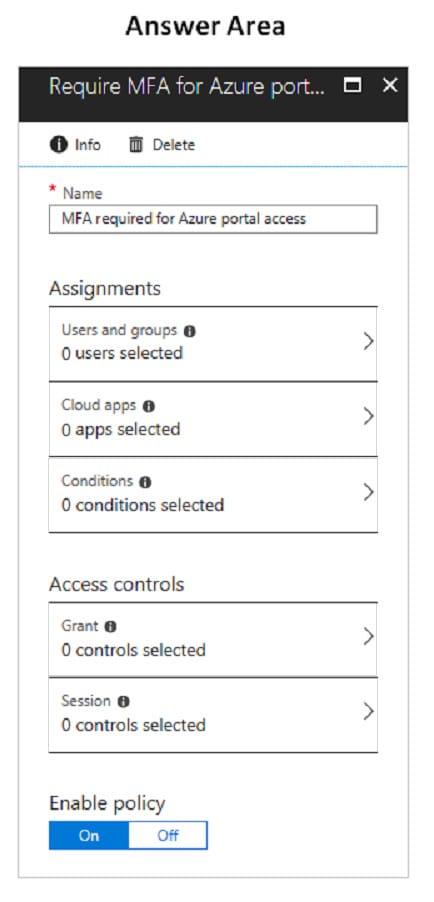
You have an Azure Active Directory (Azure AD) tenant.
You want to implement multi-factor authentication by making use of a conditional access policy. The conditional access policy must be applied to all users when they access the Azure portal.
Which three settings should you configure? To answer, select the appropriate settings to the answer area.
NOTE: Each correct selection is worth one point.
Hot Area:
Correct Answer:
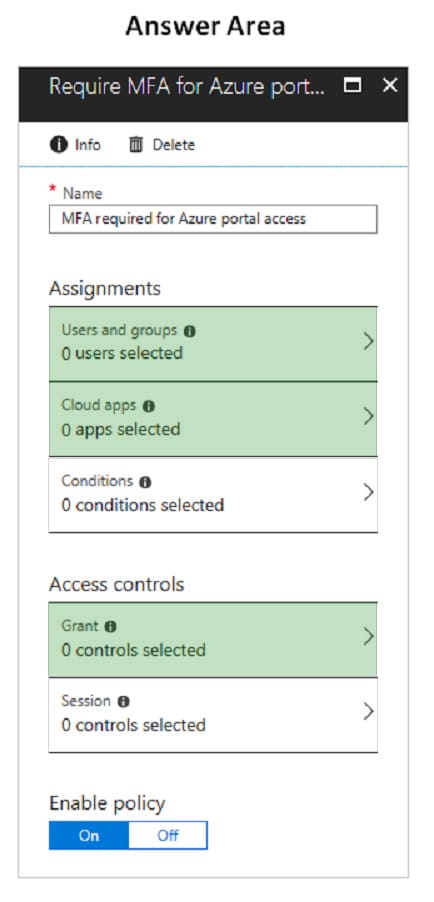
Box 1:
The conditional access policy must be applied or assigned to Users and Groups.
Box 2:
The conditional access policy must be applied when users access the Azure portal, which is a cloud app. That is: Microsoft Azure Management
Box 3:
Access control must require multi-factor authentication when granting access.
Reference:
https://docs.microsoft.com/en-us/azure/active-directory/conditional-access/app-based-mfa
Question 5:
You ate developing a web application that uses the Microsoft identity platform to authenticate users and resources. The web application calls several REST APIs.
The APIs require an access token from the Microsoft identity platform.
You need to request a token.
Which three properties should you use? Each correct answer presents part of the solution.
NOTE: Each correct selection is worth one point.
A. Application secret
B. Redirect URI/URL
C. Application name
D. Supported account type
E. Application ID
Correct Answer: ABE
Question 6:
Note: This question is part of a series of questions that present the same scenario. Each question in the series contains a unique solution that might meet the stated goals. Some question sets might have more than one correct solution, while others might not have a correct solution.
After you answer a question in this section, you will NOT be able to return to it. As a result, these questions will not appear in the review screen.
You are developing an Azure solution to collect point-of-sale (POS) device data from 2,000 stores located throughout the world. A single device can produce 2 megabytes (MB) of data every 24 hours. Each store location has one to five
devices that send data.
You must store the device data in Azure Blob storage. Device data must be correlated based on a device identifier. Additional stores are expected to open in the future.
You need to implement a solution to receive the device data.
Solution: Provision an Azure Service Bus. Configure a topic to receive the device data by using a correlation filter.
Does the solution meet the goal?
A. Yes
B. No
Correct Answer: A
A message is raw data produced by a service to be consumed or stored elsewhere. The Service Bus is for high-value enterprise messaging, and is used for order processing and financial transactions.
Reference: https://docs.microsoft.com/en-us/azure/event-grid/compare-messaging-services
Question 7:
You develop an Azure web app. You monitor performance of the web app by using Application Insights.
You need to ensure the cost for Application Insights does not exceed a preset budget.
What should you do?
A. Implement ingestions sampling using the Application Insights SDK.
B. Set a daily cap for the Application Insights instance.
C. Implement ingestion sampling using the Azure portal.
D. Implement adaptive sampling using the Azure portal.
E. Implement adaptive sampling using the Application Insights SDK.
Correct Answer: E
Sampling is an effective way to reduce charges and stay within your monthly quota.
You can set sampling manually, either in the portal on the Usage and estimated costs page; or in the ASP.NET SDK in the .config file; or in the Java SDK in the ApplicationInsights.xml file, to also reduce the network traffic.
Adaptive sampling is the default for the ASP.NET SDK. Adaptive sampling automatically adjusts to the volume of telemetry that your app sends. It operates automatically in the SDK in your web app so that telemetry traffic on the network is
reduced.
Incorrect Answers:
B: You can use the daily volume cap to limit the data collected.
To change the daily cap, in the Configure section of your Application Insights resource, in the Usage and estimated costs pane, select Daily Cap.
References:
https://docs.microsoft.com/en-us/azure/azure-monitor/app/sampling
Question 8:
HOTSPOT
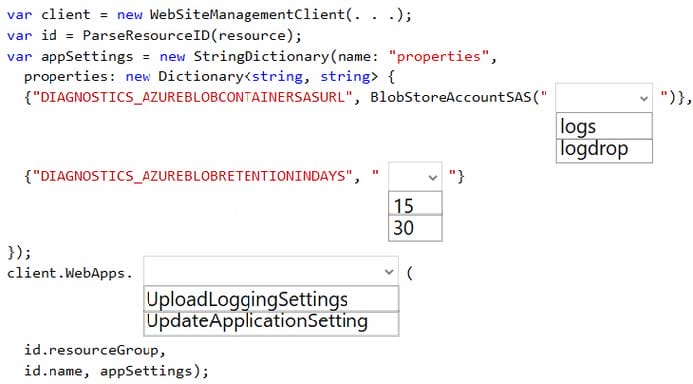
You need to implement the Log policy.
NOTE: Each correct selection is worth one point
How should you complete the EnsureLogging method in EventGridController.cs? To answer, select the appropriate options in the answer area.
Hot Area:
Correct Answer:
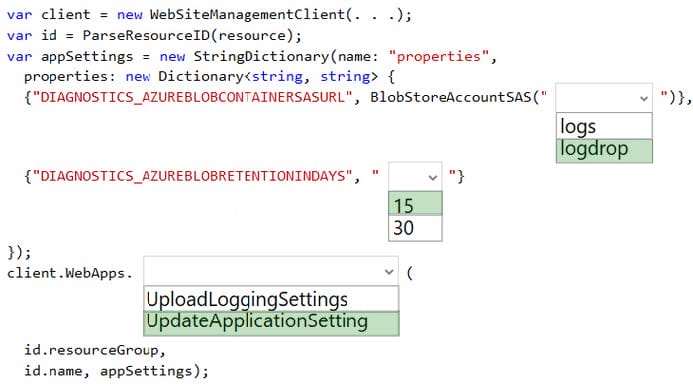
Box 1: logdrop
All log files should be saved to a container named logdrop.
Box 2: 15
Logs must remain in the container for 15 days.
Box 3: UpdateApplicationSettings
All Azure App Service Web Apps must write logs to Azure Blob storage.
Reference:
Question 9:
HOTSPOT
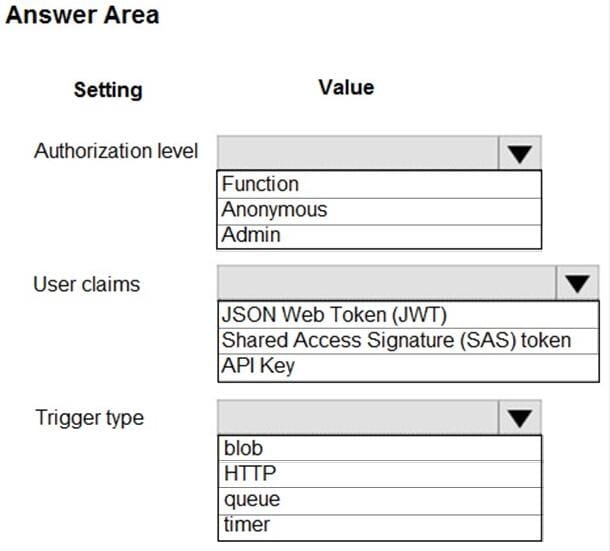
You need to secure the Shipping Function app.
How should you configure the app? To answer, select the appropriate options in the answer area.
NOTE: Each correct selection is worth one point.
Hot Area:
Correct Answer:
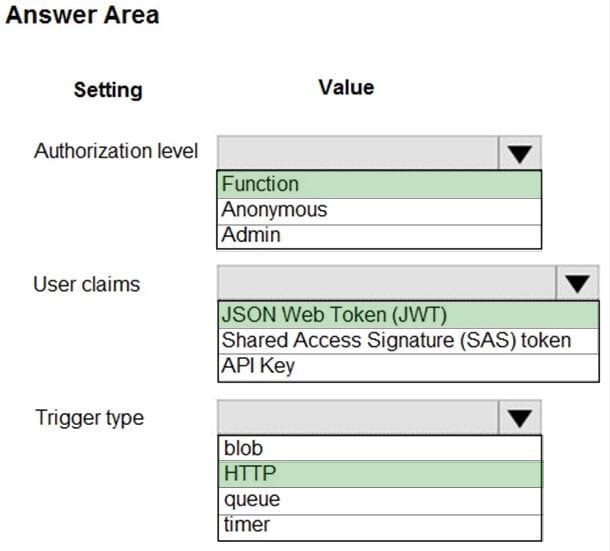
Scenario: Shipping Function app: Implement secure function endpoints by using app-level security and include Azure Active Directory (Azure AD).
Box 1: Function
Box 2: JSON based Token (JWT)
Azure AD uses JSON based tokens (JWTs) that contain claims
Box 3: HTTP
How a web app delegates sign-in to Azure AD and obtains a token
User authentication happens via the browser. The OpenID protocol uses standard HTTP protocol messages.
Reference:
https://docs.microsoft.com/en-us/azure/active-directory/develop/authentication-scenarios
Question 10:
DRAG DROP
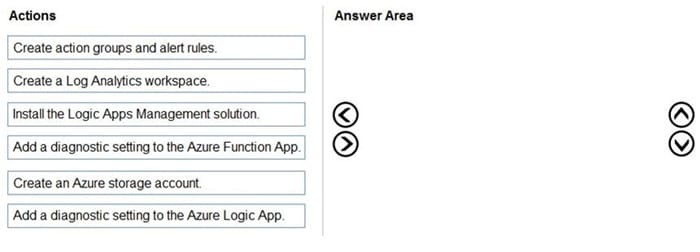
You develop and deploy an Azure Logic App that calls an Azure Function app. The Azure Function App includes an OpenAPI (Swagger) definition and uses an Azure Blob storage account. All resources are secured by using Azure Active
Directory (Azure AD).
The Logic App must use Azure Monitor logs to record and store information about runtime data and events. The logs must be stored in the Azure Blob storage account.
You need to set up Azure Monitor logs and collect diagnostics data for the Azure Logic App.
Which three actions should you perform in sequence? To answer, move the appropriate actions from the list of actions to the answer area and arrange them in the correct order.
Select and Place:
Correct Answer:
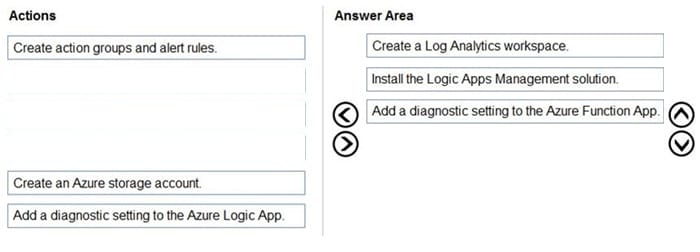
Step 1: Create a Log Analytics workspace
Before you start, you need a Log Analytics workspace.
Step 2: Install the Logic Apps Management solution
To set up logging for your logic app, you can enable Log Analytics when you create your logic app, or you can install the Logic Apps Management solution in your Log Analytics workspace for existing logic apps.
Step 3: Add a diagnostic setting to the Azure Logic App
Set up Azure Monitor logs
In the Azure portal, find and select your logic app.
On your logic app menu, under Monitoring, select Diagnostic settings > Add diagnostic setting.
Reference:
https://docs.microsoft.com/en-us/azure/logic-apps/monitor-logic-apps-log-analytics
Question 11:
HOTSPOT
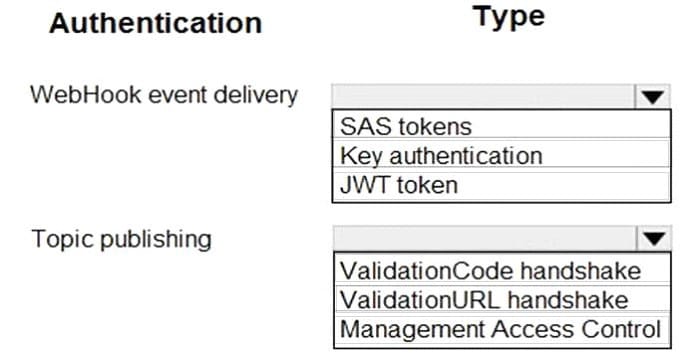
You are creating an app that uses Event Grid to connect with other services. Your app\’s event data will be sent to a serverless function that checks compliance. This function is maintained by your company.
You write a new event subscription at the scope of your resource. The event must be invalidated after 3 specific period of time. You need to configure Event Grid to ensure security.
What should you implement? To answer, select the appropriate options in the answer area;
NOTE: Each correct selection is worth one point
Hot Area:
Correct Answer:
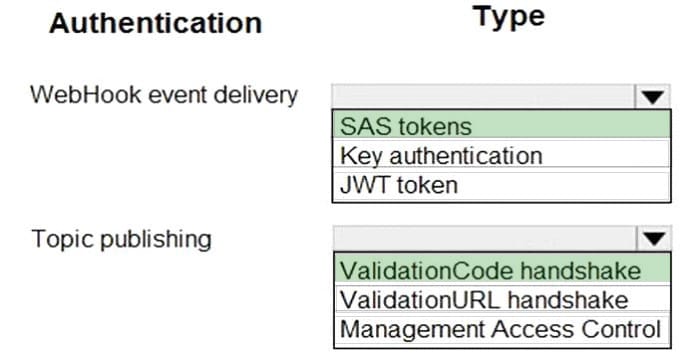
Box 1: SAS tokens
Custom topics use either Shared Access Signature (SAS) or key authentication.
Microsoft recommends SAS, but key authentication provides simple programming, and is compatible with many existing webhook publishers.
In this case we need the expiration time provided by SAS tokens.
Box 2: ValidationCode handshake
Event Grid supports two ways of validating the subscription: ValidationCode handshake (programmatic) and ValidationURL handshake (manual).
If you control the source code for your endpoint, this method is recommended.
Incorrect Answers:
ValidationURL handshake (manual): In certain cases, you can\’t access the source code of the endpoint to implement the ValidationCode handshake. For example, if you use a third-party service (like Zapier or IFTTT), you can\’t
programmatically respond with the validation code.
References:
https://docs.microsoft.com/en-us/azure/event-grid/security-authentication
Question 12:
You are building a B2B web application that uses Azure B2B collaboration for authentication. Paying customers authenticate to Azure B2B using federation.
The application allows users to sign up for trial accounts using any email address.
When a user converts to a paying customer, the data associated with the trial should be kept, but the user must authenticate using federation.
You need to update the user in Azure Active Directory (Azure AD) when they convert to a paying customer.
Which Graph API parameter is used to change authentication from one-time passcodes to federation?
A. resetRedemption
B. Status
C. userFlowType
D. invitedUser
Correct Answer: B
Question 13:
You are developing an online game that includes a feature that allows players to interact with other players on the same team within a certain distance. The calculation to determine the players in range occurs when players move and are
cached in an Azure Cache for Redis instance.
The system should prioritize players based on how recently they have moved and should not prioritize players who have logged out of the game.
You need to select an eviction policy.
Which eviction policy should you use?
A. allkeys-Iru
B. volatile-Iru
C. allkeys-lfu
D. volatile-ttl
Correct Answer: A
allkeys-lru: Keeps most recently used keys; removes least recently used (LRU) keys
In general, as a rule of thumb:
Use the allkeys-lru policy when you expect a power-law distribution in the popularity of your requests. That is, you expect a subset of elements will be accessed far more often than the rest. This is a good pick if you are unsure.
Incorrect:
volatile-lru: Removes least recently used keys with the expire field set to true.
volatile-lfu: Removes least frequently used keys with the expire field set to true.
volatile-ttl: Removes keys with expire field set to true and the shortest remaining time-to-live (TTL) value.
Use the volatile-ttl if you want to be able to provide hints to Redis about what are good candidate for expiration by using different TTL values when you create your cache objects.
Reference: https://redis.io/docs/manual/eviction/
Question 14:
HOTSPOT
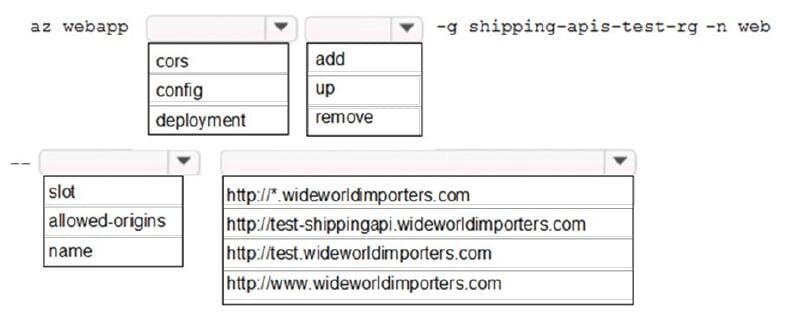
You need to update the APIs to resolve the testing error.
How should you complete the Azure CLI command? To answer, select the appropriate options in the answer area.
NOTE: Each correct selection is worth one point.
Hot Area:
Correct Answer:
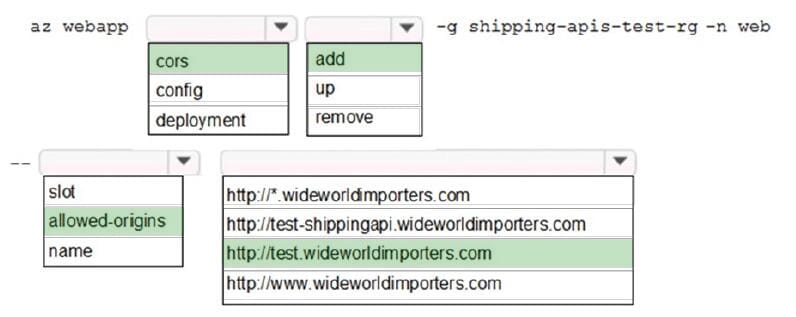
Enable Cross-Origin Resource Sharing (CORS) on your Azure App Service Web App.
Enter the full URL of the site you want to allow to access your WEB API or * to allow all domains. Box 1: cors Box 2: add Box 3: allowed-origins Box 4: http://testwideworldimporters.com/
References: http://donovanbrown.com/post/How-to-clear-No-Access-Control-Allow-Origin-header-error-with-Azure-App-Service
Question 15:
Note: This question is part of a series of questions that present the same scenario. Each question in the series contains a unique solution that might meet the stated goals. Some question sets might have more than one correct solution, while
others might not have a correct solution.
After you answer a question in this section, you will NOT be able to return to it. As a result, these questions will not appear in the review screen.
You are developing a mobile app that uses an Azure SQL Database named Weyland.
The database contains a table names Customers that has a field named email_address.
You want to implement dynamic data masking to hide the data in the email_address field.
Solution: You run the Set-AzSqlDatabaseDataMaskingPolicy -DatabaseName “Weyland” Powershell cmdlet
Does the solution meet the goal?
A. Yes
B. No
Correct Answer: B
The Set-AzSqlDatabaseDataMaskingPolicy cmdlet sets the masking policy for the database but does not set the masking rule.
Note: Masking is enabled by default.
Reference:
https://docs.microsoft.com/en-us/azure/azure-sql/database/dynamic-data-masking-overview
…
Download the complete exam practice resource! For the latest 576 AZ-204 exam questions and answers, please click >>
Conclusion:
Microsoft AZ-204 exam materials contain the latest exam questions and answers, an important piece of the puzzle to complete the ultimate goal! Study plus practical practice ensures that candidates will successfully pass the AZ-204 exam! Click here: https://www.leads4pass.com/az-204.html, to download the complete exam practice resources!

![[Update 2025] Leads4Pass AZ-204 Exam materials: Pass Azure Developer Associate Certification Exam](https://examdumpsbase.com/wp-content/uploads/2024/10/az-204-dumps.jpg)