2025 SC-200 Exam Guide: Top Free Exam Questions & Tips
When preparing for the Microsoft SC-200 Security Operations Analyst exam, many candidates first look for reliable practice resources.
Leads4Pass is one of the more popular platforms, offering practice questions and mock exams closely aligned with the official exam objectives.
Compared to blindly collecting scattered materials, using a structured Exam Materials helps you quickly identify knowledge gaps and improve answering efficiency.
This article will combine SC-200 exam materials, official learning paths, and effective study tips to help you better tackle the exam in 2025.
SC-200 Exam Overview
- Certification Name: Microsoft Certified: Security Operations Analyst Associate
- Exam Code: SC-200
- Exam Format: Multiple-choice questions, case studies, and lab simulations
- Key Skill Areas:
- Managing security operations with Microsoft Sentinel (~25%)
- Configuring detections and protections with Microsoft Defender XDR (~25%)
- Managing incident response and threat mitigation (~30%)
- Performing threat hunting using KQL queries (~20%)
The updated 2025 exam objectives place greater emphasis on cross-platform protection and automated response, making mastery of Sentinel, Defender, and KQL essential core skills.
How to Efficiently Use Leads4Pass SC-200 Exam Materials
Leads4Pass SC-200 Exam Materials are more powerful than you might think.
If your only goal is to pass the exam, they can help you achieve that.
If you want to become an industry expert, they serve as one of the best tools for practice and knowledge reinforcement. The recommended ways to use them effectively include:
- Practice by Category: Break down the SC-200 Exam Materials according to skill domains and focus on improving your weak areas.
- Combine with Official Resources: Study the official Microsoft Learn learning path first, then validate your knowledge using SC-200 Exam Materials.
- Simulate Exam Conditions: Take timed practice tests to improve both your answering speed and stress management.
- Analyze Mistakes: Create an error log, record explanations, and avoid repeating the same mistakes.
You can treat SC-200 Exam Materials as a practice collection, but it’s strongly recommended to combine them with lab environments and case studies in order to truly enhance your skills.
The Role of Leads4Pass in Exam Preparation
The advantages of Leads4Pass include:
- Timely Updates: Questions are regularly updated in line with Microsoft’s latest exam objectives.
- Variety of Question Types: Covers single-choice, multiple-choice, case studies, and lab-based scenarios.
- Explanations Included: Provides not only the answers but also reasoning to help with understanding.
Leads4Pass SC-200 Exam Questions Sharing (15 Selected Samples)
After introducing the advantages of Leads4Pass, many candidates may wonder: What kind of questions are actually included in the SC-200 exam questions?
Leads4Pass provides a complete set of 406 up-to-date exam questions and answers for the SC-200 certification, fully aligned with Microsoft’s official exam objectives. The coverage spans Microsoft Sentinel, Defender XDR, Incident Response, and KQL queries. These questions are not only closely tied to the syllabus but also come with detailed explanations to help candidates quickly grasp key points.
Due to space limitations, we cannot share all the questions here. Instead, we are offering 15 selected sample questions for free, so you can get an early feel of the exam’s difficulty and style.
By practicing these 15 sample questions, you will be able to:
- Familiarize yourself with the real exam format and wording style
- Assess your current level of knowledge and readiness
- Understand the logic behind the answers through detailed explanations, rather than rote memorization
- Build a stronger foundation for the actual exam
If you need access to the full set of 406 questions, you can visit the official Leads4Pass platform: https://www.leads4pass.com/sc-200.html
| Number of exam questions | Updated on | Related |
| 15/406 | Sep 16, 2025 | sc-100 exam prep guide |
Question 1 (Single Choice)
You have an Azure subscription that contains a user named User1.
User1 is assigned an Azure Active Directory Premium Plan 2 license.
You need to identify whether the identity of User1 was compromised during the last 90 days.
What should you use?
A. the risk detections report
B. the risky users report
C. Identity Secure Score recommendations
D. the risky sign-ins report
Correct Answer: B
Explanation:
This question tests the candidate’s understanding of Azure AD Identity Protection features.
The risky users report aggregates user-level risk events to identify if an identity was compromised over a specified period (e.g., 90 days) in a true positive scenario, whereas the risk detections report focuses on specific detections, the risky sign-ins report targets sign-in events, and Identity Secure Score provides overall security recommendations.
Question 2 (Single Choice)
The custom analytics rule which can detect threats in Azure Sentinel stopped running. The rule was disabled, and the rule name has a prefix of AUTO DISABLED. What is the problem?
A. The number of alerts exceeded 10,000 within two minutes.
B. There are connectivity issues between the data sources and Log Analytics.
C. The rule query takes too long to run and times out.
D. Permissions to one of the data sources of the rule query were modified.
Correct Answer: D
Explanation:
This question tests the candidate’s understanding of troubleshooting auto-disabled analytics rules in Microsoft Sentinel.
The “AUTO DISABLED” prefix indicates a permanent failure requiring human intervention, commonly caused by modified permissions leading to lost access to data sources (e.g., in cross-tenant scenarios).
Options A relates to alert throttling limits (which may pause rules temporarily but not auto-disable them), while B and C represent transient issues that do not trigger permanent auto-disablement.
Reference: https://docs.microsoft.com/en-us/azure/sentinel/tutorial-detect-threats-custom
Question 3 (Single Choice)
You have a Microsoft 365 subscription that uses Microsoft 365 Defender.
You plan to create a hunting query from Microsoft Defender.
You need to create a custom tracked query that will be used to assess the threat status of the subscription.
From the Microsoft 365 Defender portal, which page should you use to create the query?
A. Threat analytics
B. Advanced Hunting
C. Explorer
D. Policies and rules
Correct Answer: B
Explanation:
Advanced hunting is based on the Kusto query language.
You can use Kusto operators and statements to construct queries that locate information in a specialized schema.
Custom detection rules are rules you can design and tweak using advanced hunting queries.
These rules let you proactively monitor various events and system states, including suspected breach activity and misconfigured endpoints.
You can set them to run at regular intervals, generating alerts and taking response actions whenever there are matches.
Note: Create a custom detection rule
1.
Prepare the query.
In the Microsoft 365 Defender portal, go to Advanced hunting and select an existing query or create a new query. When using a new query, run the query to identify errors and understand possible results.
2.
Create new rule and provide alert details.
With the query in the query editor, select Create detection rule and specify the following alert details
3.
Choose the impacted entities.
Identify the columns in your query results where you expect to find the main affected or impacted entity.
4.
Specify actions.
Your custom detection rule can automatically take actions on devices, files, or users that are returned by the query.
Reference: https://learn.microsoft.com/en-us/microsoft-365/security/defender/advanced-hunting-query-language
https://learn.microsoft.com/en-us/microsoft-365/security/defender/custom-detection-rules
Question 4 (Single Choice)
A company uses Azure Security Center and Azure Defender. However, the security operator of the company doesn’t receive any email notifications for security alerts.
What should be configured in Security Center to enable the email notifications?
A. Pricing and settings
B. Security solutions
C. Security policy
D. Azure Defender
Correct Answer: A
Explanation:
This question tests the candidate’s understanding of notification configuration in Azure Security Center (now Microsoft Defender for Cloud).
Email notifications for security alerts are configured under the Pricing and settings section (or Environment settings in the updated UI), where you can specify recipients by role or email address and select severity levels for alerts.
Security solutions (B) are for enabling protection plans, Security policy (C) manages compliance standards, and Azure Defender (D) refers to the overall service, not the specific notification setup.
Question 5 (Single Choice)
You have an Azure Sentinel workspace.
You need to test a playbook manually in the Azure portal. From where can you run the test in Azure Sentinel?
A. Playbooks
B. Analytics
C. Threat intelligence
D. Incidents
Correct Answer: D
Explanation:
This question tests the candidate’s understanding of manual playbook execution in Microsoft Sentinel.
Playbooks can be tested manually by selecting an incident in the Incidents blade, then choosing “Actions > Run playbook” (or via the three-dot menu) to simulate the workflow on a specific incident without relying on automated triggers.
The Playbooks blade (A) is for creating and managing playbooks, Analytics (B) handles rule-based automation, and Threat intelligence (C) manages indicators, none of which directly support manual testing from their interfaces.
Question 6 (Single Choice)
You have a Microsoft 365 subscription that uses Microsoft Defender for Endpoint Plan 2 and contains 1,000 Windows devices.
You have a PowerShell script named Script1.ps1 that is signed digitally.
You need to ensure that you can run Script1.ps1 in a live response session on one of the devices.
What should you do first from the live response session?
A. Run the library command.
B. Upload Script1.ps1 to the library.
C. Run the putfile command.
D. Modify the PowerShell execution policy of the device.
Correct Answer: B
Explanation:
This question tests the candidate’s understanding of preparing and executing scripts in Microsoft Defender for Endpoint live response sessions.
To run a PowerShell script in a session, it must first be uploaded to the shared live response library (via the “Upload file to library” button in the session UI), making it available across sessions for commands like putfile (to transfer to the device) and run (to execute).
The script’s digital signature helps with execution policy compliance, but uploading to the library is the initial step.
Option A (library command) lists library contents but does not upload files; C (putfile) transfers files from the library to the device but requires the file to already be in the library; D is unnecessary as the first action and not directly tied to session preparation.
Question 7 (HOTSPOT)
From Azure Sentinel, you open the Investigation pane for a high-severity incident as shown in the following exhibit.
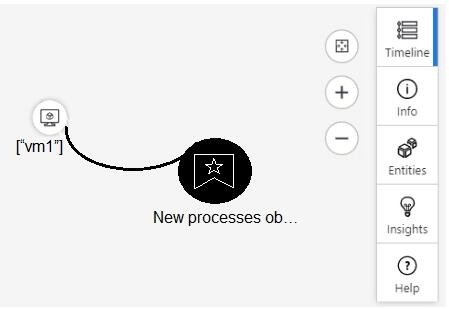
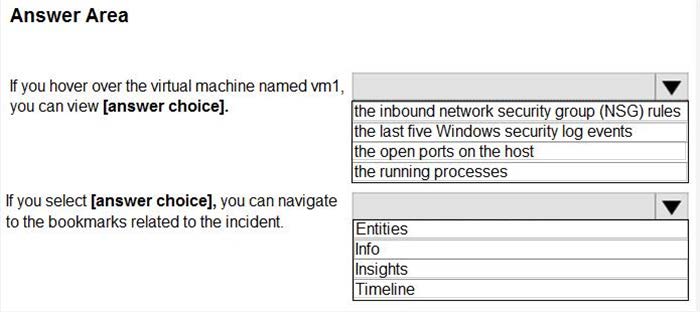
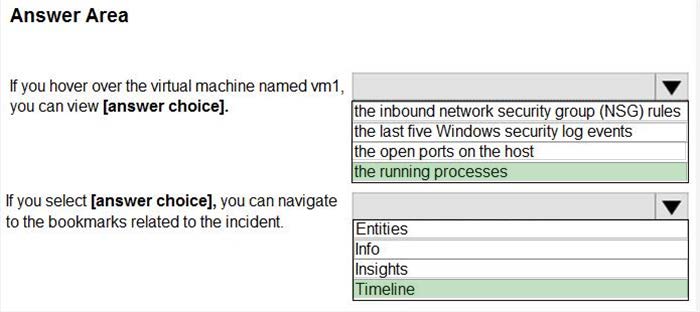
Use the drop-down menus to select the answer choice that completes each statement based on the information presented in the graphic. NOTE: Each correct selection is worth one point.
Hot Area:
Correct Answer:
Question 8 (Single Choice)
You have an Azure subscription that uses Microsoft Sentinel.
You detect a new threat by using a hunting query.
You need to ensure that Microsoft Sentinel automatically detects the threat. The solution must minimize administrative effort.
What should you do?
A. Create a playbook.
B. Create a watchlist.
C. Create an analytics rule.
D. Add the query to a workbook.
Correct Answer: C
Explanation:
This question tests the candidate’s understanding of operationalizing hunting queries in Microsoft Sentinel.
After identifying a threat via a hunting query, use the Analytics rule wizard to create a scheduled analytics rule based on the query, enabling automatic execution on a schedule and alert generation upon detection, which minimizes administrative effort by avoiding manual runs.
Playbooks (A) automate responses to existing alerts, watchlists (B) store reference data for query enrichment, and workbooks (D) provide data visualization but do not enable automated threat detection.
Reference:
https://docs.microsoft.com/en-us/azure/sentinel/analytics-create-rule
Question 9 (HOTSPOT)
You have a Microsoft 365 E5 subscription that uses Microsoft Defender 365.
Your network contains an on-premises Active Directory Domain Services (AD DS) domain that syncs with Azure AD.
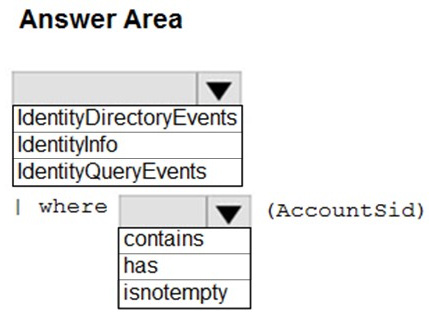
You need to identify LDAP requests by AD DS users to enumerate AD DS objects.
How should you complete the KQL query? To answer, select the appropriate options in the answer area.
NOTE: Each correct selection is worth one point.
Hot Area:
Correct Answer:
Explanation:
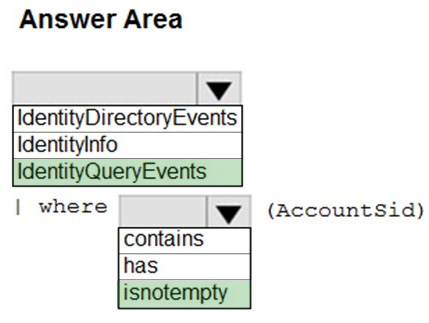
Box 1: IdentityQueryEvents
The IdentityQueryEvents table in the advanced hunting schema contains information about queries performed against Active Directory objects, such as users, groups, devices, and domains.
Box 2: isnotempty
Example:
IdentityQueryEvents
| where isnotempty(AccountSid)
| take 100
// IdentityQueryEvents
// – contains query activities performed against Active Directory objects, such as users, groups, devices, and domains monitored by Azure ATP
// – Includes SAMR, DNS and LDAP requests
// ————–
Incorrect:
IdentityInfo
The IdentityInfo table in the advanced hunting schema contains information about user accounts obtained from various services, including Azure Active Directory.
IdentityDirectoryEvents
IdentityDirectoryEvents
The IdentityDirectoryEvents table in the advanced hunting schema contains events involving an on-premises domain controller running Active Directory (AD). This table captures various identity-related events, like password changes,
password expiration, and user principal name (UPN) changes. It also captures system events on the domain controller, like scheduling of tasks and PowerShell activity.
Reference: https://learn.microsoft.com/en-us/microsoft-365/security/defender/advanced-hunting-identityqueryevents-table https://learn.microsoft.com/en-us/microsoft-365/security/defender/advanced-hunting-identitydirectoryevents-table https://github.com/microsoft/Microsoft-365-Defender-Hunting-Queries/blob/master/Webcasts/TrackingTheAdversary/Episode%201%20-%20KQL%20Fundamentals.txt
Question 10 (HOTSPOT)
You have a Microsoft 365 E5 subscription that uses Microsoft Teams.
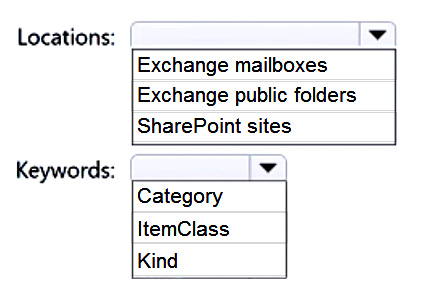
You need to perform a content search of Teams chats for a user by using the Microsoft Purview compliance portal. The solution must minimize the scope of the search.
How should you configure the content search? To answer, select the appropriate options in the answer area.
NOTE: Each correct selection is worth one point.
Hot Area:
Correct Answer:
Explanation:
This question tests the candidate’s understanding of configuring targeted content searches in Microsoft Purview for Teams content.
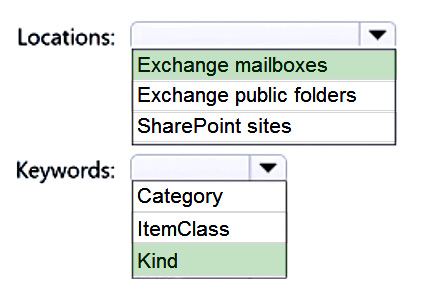
To minimize scope for a specific user’s Teams chats (1:1 and group chats), select only Exchange mailboxes and specify the user’s mailbox, as chat messages are stored there as email-like items; including SharePoint sites or public folders would unnecessarily broaden the search to channel posts or unrelated content.
For keywords, use the “Kind” condition (e.g., Kind:microsoftteams or Kind:IM) to filter specifically to Teams instant messages, avoiding broader options like Category (for labels) or Item class (for general message types).
Question 11 (Single Choice)
A company uses Azure Sentinel.
You need to create an automated threat response.
What should you use?
A. a data connector
B. a playbook
C. a workbook
D. a Microsoft incident creation rule
Correct Answer: B
Explanation:
This question tests the candidate’s understanding of automation capabilities in Microsoft Sentinel. Playbooks, built on Azure Logic Apps, enable automated threat responses by triggering workflows (e.g., isolating devices, sending notifications, or enriching alerts) in response to incidents or alerts, streamlining remediation without manual intervention.
Data connectors (A) ingest log data into Sentinel, workbooks (C) provide interactive dashboards for visualization and reporting, and Microsoft incident creation rules (D) aggregate alerts into incidents but do not handle response automation.
Reference: https://docs.microsoft.com/en-us/azure/sentinel/tutorial-respond-threats-playbook
Question 12 (Single Choice)
Note: This question is part of a series of questions that present the same scenario. Each question in the series contains a unique solution that might meet the stated goals. Some question sets might have more than one correct solution, while others might not have a correct solution.
After you answer a question in this section, you will NOT be able to return to it. As a result, these questions will not appear in the review screen.
You use Azure Security Center.
You receive a security alert in Security Center.
You need to view recommendations to resolve the alert in Security Center.
Solution: From Security alerts, you select the alert, select Take Action, and then expand the Prevent future attacks section.
Does this meet the goal?
A. Yes
B. No
Correct Answer: B
Explanation:
This question tests the candidate’s understanding of remediation workflows in Microsoft Defender for Cloud (formerly Azure Security Center).
The proposed solution focuses on the “Prevent future attacks” section under Take Action, which provides preventive recommendations to avoid recurrence but does not display options for resolving or mitigating the current alert.
To view recommendations for resolving the existing alert, select “Mitigate the threat” instead, which offers immediate remediation steps tailored to the specific incident.
Question 13 (Single Choice)
Note: After you answer a question in this section, you will NOT be able to return to it. As a result, these questions will not appear in the review screen.
You have Linux virtual machines on Amazon Web Services (AWS).
You deploy Azure Defender and enable auto-provisioning.
You need to monitor the virtual machines by using Azure Defender.
Solution: You manually install the Log Analytics agent on the virtual machines.
Does this meet the goal?
A. Yes
B. No
Correct Answer: B
Explanation:
This question tests the candidate’s awareness of post-retirement changes for the Log Analytics agent (also known as the Microsoft Monitoring Agent or MMA) in Microsoft Defender for Cloud, which occurred in November 2024.
The proposed solution of manually installing the deprecated Log Analytics agent on AWS Linux VMs does not enable monitoring, as auto-provisioning applies only to Azure VMs and the agent is no longer supported for security features like Defender for Servers.
Instead, for multi-cloud environments like AWS, connect the AWS account to Defender for Cloud, use Azure Arc for server onboarding, enable agentless machine scanning (in preview for AWS instances), and leverage Microsoft Defender for Endpoint for endpoint protection, ensuring comprehensive coverage without relying on the retired agent.
Question 14 (Hotspot)
You have a Microsoft 365 subscription that uses Microsoft Defender for Endpoint Plan 2 and contains a Windows device named Device1.
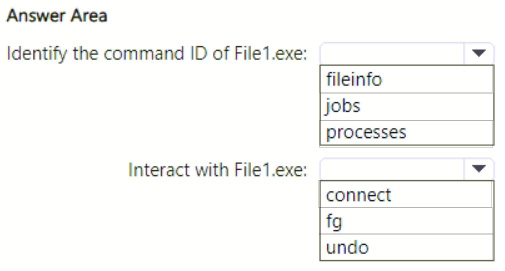
You initiate a live response session on Device1 and launch an executable file named File1.exe in the background.
You need to perform the following actions:
- Identify the command ID of File1.exe.
- Interact with File1.exe.
Which live response command should you run for each action? To answer, select the appropriate options in the answer area.
NOTE: Each correct selection is worth one point.
Answer Area
Correct Answer:
Explanation:
This question tests the candidate’s understanding of managing background processes in Microsoft Defender for Endpoint live response sessions.
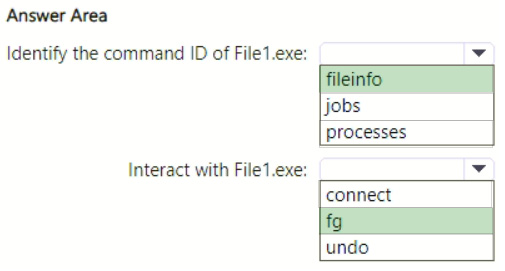
When an executable like File1.exe is launched in the background (e.g., via run File1.exe &), the jobs command lists all running jobs, including their command IDs and status, allowing identification of the specific ID for File1.exe.
To interact with it (e.g., bring it to the foreground for monitoring or control), use fg <command ID> with the ID from jobs, as fg operates on command IDs, not PIDs.
Other options like fileinfo (A) retrieves file metadata but not job IDs, processes (C) lists running processes by PID, connect (A for second) is not a valid live response command, and undo (C for second) cancels the last command but does not interact with background jobs.
Question 15 (Single Choice)
You have 50 Microsoft Sentinel workspaces.
You need to view all the incidents from all the workspaces on a single page in the Azure portal. The solution must minimize administrative effort.
Which page should you use in the Azure portal?
A. Microsoft Sentinel – Incidents
B. Microsoft Sentinel – Workbooks
C. Microsoft Sentinel
D. Log Analytics workspaces
Correct Answer: A
Explanation:
When you open Microsoft Sentinel, you are presented with a list of all the workspaces to which you have access rights, across all selected tenants and subscriptions.
To the left of each workspace name is a checkbox. Selecting the name of a single workspace will bring you into that workspace. To choose multiple workspaces, select all the corresponding checkboxes, and then select the View incidents button at the top of the page.
Reference: https://learn.microsoft.com/en-us/azure/sentinel/multiple-workspace-view
Study Tips and Time Management
To pass the SC-200 exam efficiently within 4–6 weeks, you can follow the schedule below:
- Week 1–2: Review the official exam objectives and focus on learning the core features of Microsoft Sentinel and Defender.
- Week 3–4: Concentrate on practicing KQL queries and case studies, using SC-200 exam materials to reinforce knowledge.
- Week 5: Take a full-length mock exam and review mistakes and difficult topics.
- Final Stage: Focus on revising high-weight question types, maintain a steady pace, and adjust your study rhythm.
Extra Tip:
Make use of the Azure free subscription to perform hands-on labs and deepen your understanding.
Frequently Asked Questions
Q1: Can I pass the exam using only SC-200 exam materials?
A1: There is a pass rate of over 95%, but in 2025 the best approach is to combine SC-200 exam materials + official documentation + lab practice to truly enhance your skills.
Q2: Is the SC-200 exam difficult?
A2: If you are familiar with Microsoft Sentinel, Defender, and KQL, and have undergone systematic training, the difficulty level is moderate.
Q3: How many hours should I study each day?
A3: It is recommended to study at least 1–2 hours per day, and increase intensity during the last two weeks before the exam.
Q4: Which Exam materials do you recommend?
A4: Leads4Pass.
Q5: What is the value of the SC-200 certification?
A5: It is highly sought after in roles such as security analyst, SOC operations, and cloud security positions, significantly boosting career competitiveness.
Conclusion
If your goal is simply to obtain the certification, SC-200 exam materials are enough!
When preparing for the SC-200 exam, Leads4Pass provides high-quality SC-200 exam materials as practice exam materials.
However, if you want not only to pass the exam but also to acquire truly practical security operations skills, it is strongly recommended to combine official resources + high-quality exam materials + hands-on lab practice. With proper planning and systematic training, you can achieve 100% success.
