Where can I get really useful MB-820 Exam Materials?
Hello everyone!
You’ve come to the right place.
Next, I will tell you where to find really useful MB-820 exam materials.
First, everyone needs to know that MB-820 was released in beta in January 2024 and officially exited beta on April 11, 2024, becoming a formal exam.
Shortly after the release, I wrote an article titled “How to Pass Microsoft Dynamics 365 MB-820 Exam,” in which I shared exam strategies and the latest practice questions.
The changes you need to address
According to the official Microsoft Learn study guide, the update on June 10, 2025, will bring changes to the following skill areas:
- Install and configure the Business Central development environment: Minor adjustments are expected, with specific details yet to be fully disclosed.
- Implement APIs: Significant updates are anticipated, potentially involving new API functionalities or technical requirements.
The percentage weights of other skill areas (such as describing Business Central, developing AL objects, etc.) remain unchanged for now.
What are really useful MB-820 exam materials?
Real-time updated exam practice questions that ensure complete coverage of the latest changes in the MB-820: Dynamics 365 Business Central Developer Associate certification exam. They assist you in effectively practicing for the test—this is the value of MB-820 exam materials. The latest MB-820 exam materials currently include 113 exam questions and answers. You are welcome to download and use them at https://www.leads4pass.com/mb-820.html, ensuring you pass on your first attempt.
Next, I will share the latest practice questions for free:
2025 MB-820 exam materials Practice Questions
Tip: Displaying more practice questions is not as effective as providing real-time, valid ones.
Question 1:
HOTSPOT
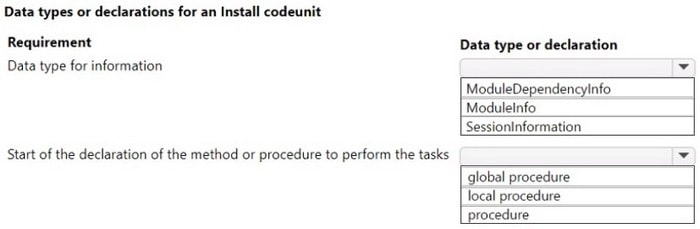
You need to create the Install codeunit that is required in the extension used for installing or updating the Housekeeping app.
Which data type or declaration should you use? To answer, select the appropriate options in the answer area.
NOTE: Each correct selection is worth one point.
Hot Area:
Correct Answer:
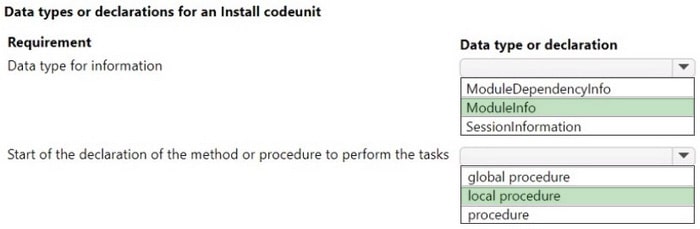
Box 1: ModuleInfo
Data type for information
ModuleInfo
Represents information about an application consumable from AL.
Scenario: Department-specific requirements. Housekeeping department
The department requires the development of an extension with a new API page named RoomsAPI.
*
The housekeeping team will use RoomsAPI to publish room details, update when work is complete, or provide repair notifications from the canvas app.
*-> This custom API page must expose a custom table named Rooms and have an ID 50000. The table must be able to update from the PMS. The PMS team must know the *endpoint to connect to the custom API*.
Note: Data Types and Methods in AL
The following data types are available as part of the AL Language. Each data type has various methods that support it.
*
ModuleInfo
Represents information about an application consumable from AL.
Incorrect:
*
ModuleDependencyInfo
Provides information about a dependent module.
*
SessionInformation
Is a complex data type for exposing Session information into AL.
Box 2: local procedure Procedure scope To declare a local method, start the declaration with local:
local procedure Mymethod(); To declare a global method, omit local: procedure Mymethod();
Scenario: The code required to perform tasks cannot be accessible from other parts of the application.
Reference:
https://learn.microsoft.com/en-us/dynamics365/business-central/dev-itpro/developer/methods-auto/library https://learn.microsoft.com/en-us/dynamics365/business-central/dev-itpro/developer/devenv-al-methods
Question 2:
Note: This question is part of a series of questions that present the same scenario. Each question in the series contains a unique solution that might meet the stated goals. Some question sets might have more than one correct solution, while others might not have a correct solution.
After you answer a question in this section, you will NOT be able to return to it. As a result, these questions will not appear on the review screen.
A company creates a Business Central app and a table named MyTable to store records when sales orders are posted.
Users report the following issues:
1.
The users receive permission errors related lo MyTable.
2.
Users are no longer able to post sales orders since installing the new app.
3.
The users cannot access the list page created in MyTable.
You need to resolve the user issues without creating new permission sets. You must use the principle of least privilege.
Solution: In the MyTable object add the property InherentPermissions = Rl. Does the solution meet the goal?
A. Yes
B. No
Correct Answer: B
The property InherentPermissions is used to automatically grant permissions to the table object it is applied to, but setting it to Rl (which seems to be a typo and should likely be \’RL\’ for Read and Insert permissions) is not sufficient in this scenario.
The issues reported by the users suggest that they need more than just read and insert permissions on MyTable. Since users are unable to post sales orders, they likely need Modify, Delete, or Execute permissions on certain tables or objects related to the sales order process.
Additionally, the inability to access the list page created in MyTable could be due to lacking Read permissions on other related objects or pages.
Therefore, merely setting InherentPermissions = RL on MyTable does not comprehensively address the users\’ permission issues, especially when considering the principle of least privilege. A more tailored approach to permissions, potentially involving adjustments to the app\’s code or configuration to ensure proper permissions are applied where necessary, would be needed.
Question 3:
You need to determine if you have unwanted incoming web service calls in your tenant during the last seven days.
Which two KQL queries should you use? Each correct answer presents a complete solution.
NOTE: Each correct selection is worth one point.
A. traces | where timestamp > ago(7d) | where customDimensions has \’RT0008\’ | where customDimensions.category !in (\’ODataV4\’, \’ODataV3\’, \’Api\’)
B. traces | where timestamp > ago(7d) | where customDimensions has \’RT0008\’ | where customDimensions.category == \’SOAP\’
C. traces | where timestamp > ago(7d) | where customDimensions == \’RT0008\’ | where customDimensions.category == \’SOAP\’
D. traces | where timestamp > ago(7d) | where customDimensions has \’RT0008\’ | where customDimensions.category != \’ODataV4\’
E. traces | where timestamp > ago(7d) | where customDimensions has \’RT0008\’ | where customDimensions.category !in (\’ODataV4\’, \’Api\’)
Correct Answer: BC
Analyzing Incoming Web Services Request Telemetry
Web services telemetry gathers data about SOAP, OData, and REST API requests to the service. It provides information like the request\’s endpoint, time to complete, HTTP status codes, and more.
What type of web services are called (REST API, OData, or SOAP)?
The custom dimension category hold information about the type of endpoint (REST API, OData, or SOAP) being called.
This KQL code illustrates how you can find which endpoints are being called and which types of endpoints are being used. Such information might be useful, should you want to modernize your use of web services to use REST APIs, which is
recommended over using SOAP web services or OData web services based on pages.
// Incoming Web Service Requests – endpoint information
traces
| where timestamp > ago(1d) // change as needed
| where customDimensions has “RT0008”
| where customDimensions.eventId == “RT0008”
| project timestamp
// endpoint information
, category = customDimensions.category // API, ODataV3, ODataV4, or SOAP
, endpoint = customDimensions.endpoint // URI
Scenario:
Contoso, Ltd. interacts with external services provided by customers and partners. Different applications interact with SOAP and OData endpoints exposed from Business Central.
SOAP
Contoso, Ltd. plans to dismiss using the SOAP protocol for integrations.
Contoso, Ltd. must be able to detect if external applications are using its Business Central SOAP endpoints.
Reference:
Question 4:
HOTSPOT
You develop a test application.
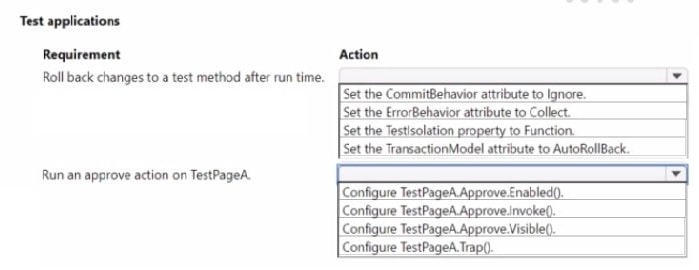
You must meet the following requirements:
1.
Roll back changes to a test method after run time.
2.
Run an approve action on a test page named TestPageA.
You need to implement the given requirements on the test codeunit
Which actions should you perform? To answer, select the appropriate options in the answer area
NOTE: Each correct selection is worth one point.
Hot Area:
Correct Answer:
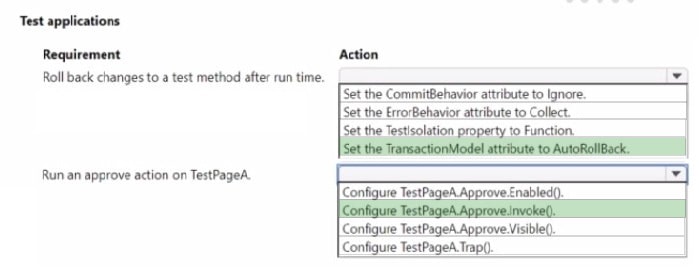
To roll back changes to a test method after run time, you should:
Set the TransactionModel attribute to AutoRollback. To run an approve action on a test page named TestPageA, you should:
Configure TestPageA.Approve.Invoke().
In Business Central\’s testing framework, the TransactionModel attribute can be set to AutoRollback. This ensures that any changes made during the test are rolled back after the test is complete, leaving the database in its original state. For
running an action on a test page, you would use the \’Invoke\’ method on the action you wish to perform. In this case, to run an approve action on TestPageA, you would use TestPageA.Approve.Invoke() within your test codeunit. This simulates
the user action of approving something on the page.
These actions ensure that the testing environment is properly set up to test specific functionalities without persisting test data and to invoke actions as part of the test scenarios.
Question 5:
HOTSPOT
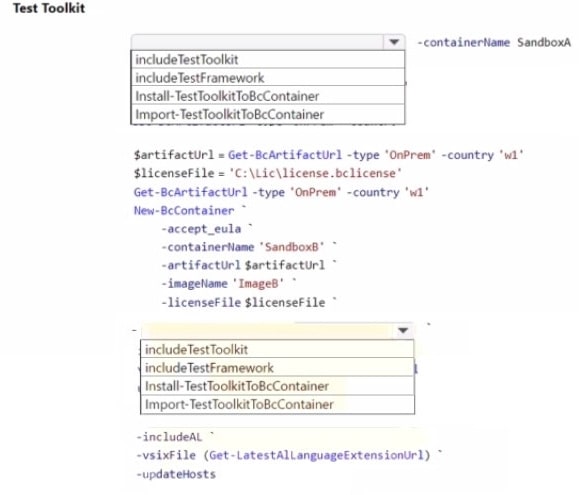
A company plans to integrate tests with its build pipelines.
The company has two Docket sandbox environments: SandboxA and SandboxB.
You observe the following:
1.
SandboxA is configured without the Test Toolkit installed.
2.
SandboxB must be configured from scratch. The Test Toolkit must be installed in SandboxB during configuration.
You need to configure the sandbox environments.
How should you complete the cmdlets? To answer, select the appropriate options in the answer area.
Hot Area:
Correct Answer:
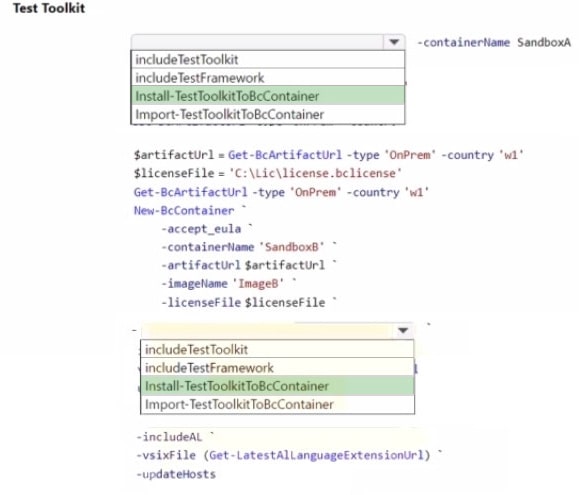
Based on the PowerShell script snippet you\’ve provided and the scenario described, you need to configure Docker sandbox environments for a company with specific requirements for Test Toolkit installations.
For SandboxA, since it is configured without the Test Toolkit installed, you would typically use the PowerShell cmdlet Install-TestToolkitToBcContainer to install the Test Toolkit into the Business Central Docker container.
For SandboxB, which must be configured from scratch with the Test Toolkit installed during configuration, you would include the Test Toolkit as part of the New-BcContainer script block that creates the container.
The relevant cmdlets and parameters for SandboxB would include:
-includeTestToolkit: This parameter ensures that the Test Toolkit is included during the creation of the new container.
Given the limited context from the image, here\’s how you should complete the cmdlets for SandboxB:
Add -includeTestToolkit in the New-BcContainer script to ensure the Test Toolkit is installed when creating SandboxB.
Since you are setting up SandboxB from scratch, you don\’t need to run Install- TestToolkitToBcContainer separately as the toolkit will be included at the time of container creation with the -includeTestToolkit parameter. For the New-
BcContainer cmdlet, you would fill in the placeholders with the appropriate values for artifactUrl, imageName, and licenseFile if they are required for your specific setup.
Question 6:
HOTSPOT
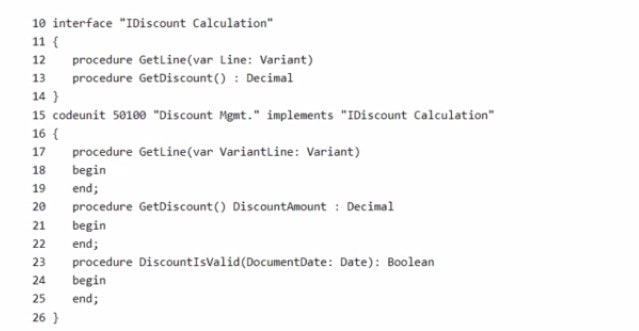
You have a per tenant extension that contains the following code.
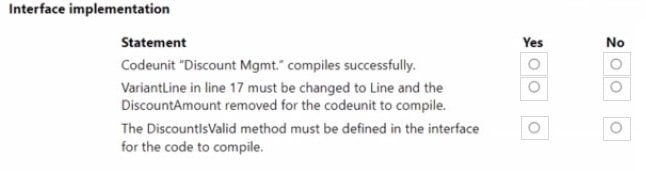
For each of the following statements, select Yes if the statement is true. Otherwise, select No. NOTE: Each correct selection is worth one point.
Hot Area:
Correct Answer:
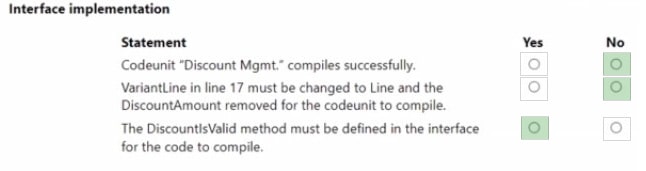
Codeunit “Discount Mgmt.” compiles successfully. = NO VariantLine in line 17 must be changed to Line and the DiscountAmount removed for the codeunit to compile. = NO
The DiscountIsValid method must be defined in the interface for the code to compile. = YES
The codeunit “Discount Mgmt.” will not compile successfully as is because the DiscountIsValid method is not defined in the “IDiscount Calculation” interface, yet it is being declared in the codeunit which implements this interface. AL requires
that all procedures in the codeunit that implements an interface must be defined in the interface itself.
The VariantLine in line 17 does not need to be changed to Line, nor does the DiscountAmount need to be removed for the codeunit to compile. These are valid declarations in AL and they are correctly implemented in the codeunit. The Variant
data type in AL is used to handle various data types and DiscountAmount is a valid return type for a procedure.
For the code to compile successfully, the DiscountIsValid method must be included in the interface because AL enforces that any codeunit implementing an interface must implement all the methods defined in that interface.
Question 7:
A company is deploying Business Central on-premises.
The company plans to use a single-tenant deployment architecture.
You need to describe how the data is stored and how the Business Central Server is configured.
In which two ways should you describe the single-tenant architecture? Each correct answer presents a complete solution.
NOTE: Each correct selection is worth one point.
A. Each customer has their own Business Central Server.
B. The application and the business data are stored in the same database.
C. Multiple customers share a single Business Central Server.
D. The application and business data are stored in separate databases.
E. Multiple customers share multiple Business Central Server instances.
Correct Answer: BD
In a single-tenant deployment architecture of Business Central on-premises, the following characteristics describe how the data is stored and how the Business Central Server is configured:
The application and the business data are stored in the same database (B): In a single-tenant architecture, each tenant (which typically corresponds to a single customer) has its own dedicated database.
This database contains both the application objects (such as pages, reports, codeunits, etc.) and the business data (such as customer, vendor, and transaction records).
This setup ensures that each tenant\’s data is isolated and can be managed independently. The application and business data are stored in separate databases (D):
While (B) is a characteristic of a single-tenant deployment, it\’s important to clarify that in some configurations, the application objects can be stored in a separate database from the business data.
This approach can be used for easier maintenance and upgrades of the application code without affecting the business data. However, each tenant still has its own set of databases, maintaining the single-tenancy model.
The other options provided do not accurately describe a single-tenant architecture: Each customer has their own Business Central Server (A):
This statement might be misleading. In a single-tenant deployment, while each customer has their own database, they do not necessarily have their own Business Central Server instance.
Multiple databases (tenants) can be hosted on a single server instance, although they are not shared across customers. Multiple customers share a single Business Central Server (C) and Multiple customers share multiple Business Central Server instances (E):
These options describe a multi-tenant architecture rather than a single-tenant one. In a multi- tenant setup, multiple customers (tenants) can share the same server instance and even the same application database, with data isolation ensured at the application level.
Question 8:
You are developing an app that will be published to Microsoft AppSource.
The app requires code analyzers to enforce some rules. You plan to add the analyzers to the settings.json file.
You need to activate the analyzers for the project.
Which three code analyzers should you activate to develop the app for AppSource? Each correct answer presents part of the solution
NOTE: Each correct selection is worth one point.
A. CodeCop
B. UlCop
C. a custom rule set
D. PerTenantExtensionCop
E. AppSourceCop
Correct Answer: ADE
When developing an app for Microsoft AppSource, it is crucial to adhere to specific guidelines and standards to ensure compatibility and compliance. The three code analyzers you should activate are:
CodeCop (A): This is the default analyzer for AL language extensions. It enforces the AL Coding Guidelines, ensuring that the code follows best practices for readability, maintainability, and performance. It checks for a wide range of issues,
from syntax errors to best practice violations, making it essential for any AL development.
PerTenantExtensionCop (D): This analyzer is specifically designed for extensions that are intended to be installed for individual tenants. It includes rules that ensure the extension does not interfere with the per-tenant customizations and
adheres to the guidelines for extensions that can be safely installed and uninstalled without affecting the underlying application. AppSourceCop (E): This analyzer is tailored for extensions that are intended for publication on Microsoft
AppSource. It enforces additional rules that are specific to AppSource submissions, such as checking for the use of reserved object ranges and ensuring that all prerequisite dependencies are correctly declared. This is crucial for ensuring
that your app meets all the requirements for listing on AppSource. By activating these three analyzers, developers can ensure their app adheres to the standards required for AppSource, as well as maintain high code quality and compatibility
with Business Central.
Question 9:
You need to allow debugging in an extension to view the source code. In which file should you specify the value of the allowDebugging property?
A. settings.json
B. rad.json
C. app.json
D. launchjson
Correct Answer: C
To enable debugging in an extension and allow the source code to be viewed, the allowDebugging property should be specified in the app.json file (C).
The app.json file serves as the manifest for an AL project in Microsoft Dynamics 365 Business Central, defining the project\’s properties, dependencies, and features.
By setting the allowDebugging property to true in this file, developers enable the debugging of the extension\’s source code, facilitating troubleshooting and development.
This is essential for analyzing the behavior of the extension and identifying issues during the development process.
Question 10:
A company has a task that is performed infrequently. Users often need to look up the procedure to complete the task.
The company requires a wizard that leads users through a sequence of steps to complete the task.
You need to create the page to enable the wizard creation.
Which page type should you use?
A. NavigatePage
B. Card
C. RoleCenter
D. List
Correct Answer: A
For a task that is performed infrequently and requires users to follow a sequence of steps, a wizard-like interface is ideal.
In Microsoft Dynamics 365 Business Central, the NavigatePage page type (A) is best suited for this purpose. NavigatePage is designed to guide users through a series of steps or pages, allowing them to complete a task by making choices or entering data in a structured manner.
This page type is often used for setup wizards, data migration tasks, or any other process that benefits from a step-by-step approach. Unlike the other page types like Card (B), RoleCenter (C), or List (D), NavigatePage specifically supports the navigation and decision-making flow required for wizard creation, making it the optimal choice for this requirement.
Question 11:
HOTSPOT
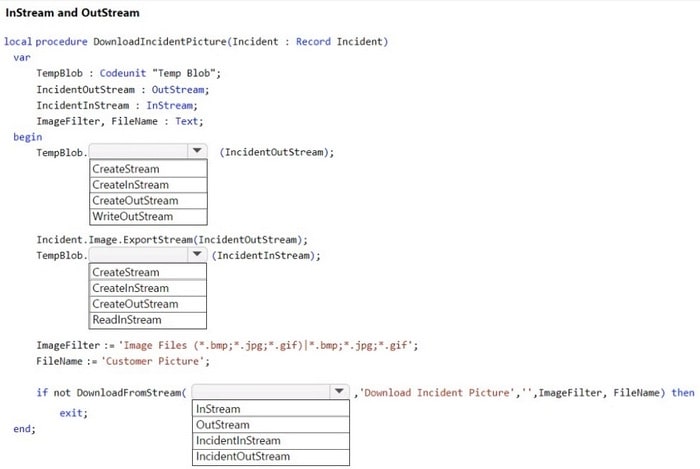
You need to download a stored picture from the Room Incident page.
How should you complete the code segment? To answer, select the appropriate options in the answer area.
NOTE: Each correct selection is worth one point.
Hot Area:
Correct Answer:
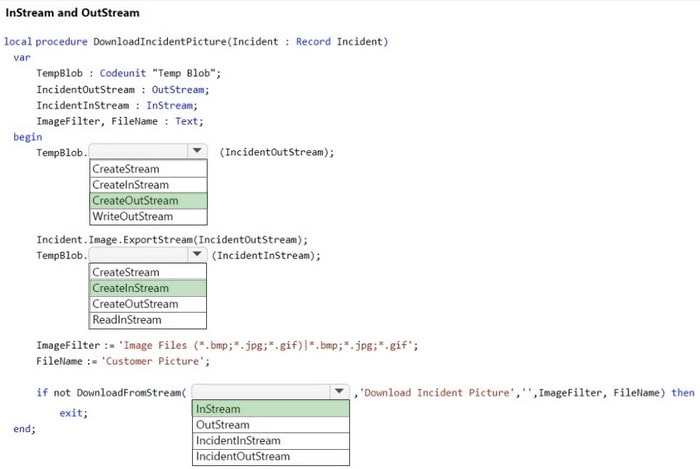
Box 1: CreateOutStream Box 2: CreateInStream Box 3: Instream Reference:
https://community.dynamics.com/blogs/post/?postid=19ce850a-6ff7-4b99-8b3c-65aa6411771b
Question 12:
You are developing an app.
You plan to publish the app to Microsoft AppSource.
You need to assign an object range for the app.
Which object range should you use?
A. custom object within the range 50000 to 59999
B. custom object within the range 50000 to 99999
C. divided by countries and use specific a country within the range 100000 to 999999
D. an object range within the range of 7000000 to 74999999 that is requested from Microsoft
E. free object within the standard range 1 to 49999
Correct Answer: D
When developing an app for Microsoft AppSource, it is essential to use an object range that is specifically designated by Microsoft to avoid conflicts with other apps and the base application.
The correct object range to use is: An object range within the range of 70000000 to 74999999 that is requested from Microsoft (D): This range is reserved for AppSource apps.
Developers need to request this range from Microsoft to ensure that the objects used in their extension do not conflict with those used by other extensions or by the base application.
Using this reserved range helps maintain the integrity and compatibility of extensions published on AppSource. It\’s important to note that the other ranges mentioned (A, B, C, and E) are not suitable for apps intended for AppSource.
Ranges 50000 to 59999 and 50000 to 99999 are typically reserved for per-tenant customizations or partner solutions, not for distribution on AppSource.
The standard range 1 to 49999 is reserved for the base application objects, and using an object range divided by countries (C) is not a standard practice for AppSource apps.
Question 13:
You need to determine why the debugger does not start correctly.
What is the cause of the problem?
A. The “userId” parameter must have the GUID of the user specified, not the username.
B. The “breakOnNext” parameter is not set to “WebServiceClient”.
C. The “userId” parameter is specified, and the next user session that is specified in the “breakOnNext” parameter is snapshot debugged.
D. The “executionContext” parameter is not set to “Debug”.
Correct Answer: A
Initialize a snapshot debugging session
You can start a snapshot by creating a snapshot configuration file in Visual Studio Code.
Choose whether to run the session on a cloud service or locally. The configuration file contains the following information.
*
userId The GUID of the user who initiated the process to start snapshot debugging. For on-premises, this can also be the user name in user password authentication scenarios. The user must be able to start, or have a session type opened that is specified in the breakOnNext parameter.
*
Etc.
Scenario: Debugging problems A user of the ISSUE BASE extension in Business Central reports a problem.
You discover that the debugging is not triggering.
Incorrect:
Not B: Example (attach to a web client session)
The following example illustrates a configuration for a local server, where you want to debug a web client session.
…
{
“name”: “My attach to local server”,
“type”: “al”,
“request”: “attach”,
“server”: “https://localhost”,
“serverInstance”: “BC200”,
“authentication”: “Windows”,
“breakOnError”: true,
“breakOnRecordWrite”: false,
“enableSqlInformationDebugger”: true,
“enableLongRunningSqlStatements”: true,
“longRunningSqlStatementsThreshold”: 500,
“numberOfSqlStatements”: 10,
“breakOnNext”: “WebClient”
} …
Reference:
https://learn.microsoft.com/en-us/dynamics365/business-central/dev-itpro/developer/devenv-attach-debug-next https://learn.microsoft.com/en-us/dynamics365/business-central/dev-itpro/developer/devenv-snapshot-debugging
Question 14:
You plan to write unit test functions to test newly developed functionality in an app.
You must create a test codeunit to write the functions.
You need to select the property to use for the test codeunit.
Which property should you use to ensure that the requirements are fulfilled?
A. SubType
B. Access
C. Description
Correct Answer: A
When creating a test codeunit in Microsoft Dynamics 365 Business Central to write unit test functions, the SubType property (A) of the codeunit should be set to Test.
This property is crucial for defining the codeunit\’s purpose and behavior within the application.
By setting the SubType property to Test, you are indicating that the codeunit contains test functions intended to validate the functionality of other parts of the application, such as customizations or new developments.
This distinction ensures that the testing framework within Business Central recognizes the codeunit as a container for test functions, allowing it to execute these functions in a testing context, which can include setting up test data, running the tests, and cleaning up after the tests have completed.
Question 15:
HOTSPOT
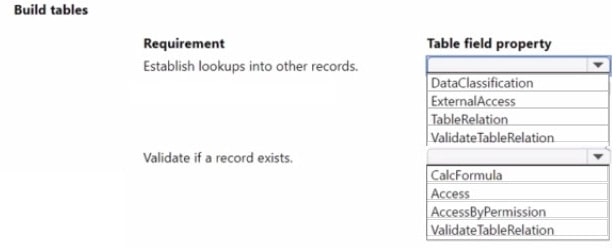
You plan to create a table to hold client data.
You have the following data integrity requirements:
1.
Lookups into other records must be established.
2.
Validate if a record exists in a destination record.
You need to select the table field property to use for each requirement.
Which table field property should you use? To answer, select the appropriate options in the answer area.
NOTE: Each correct selection is worth one point.
Hot Area:
Correct Answer:
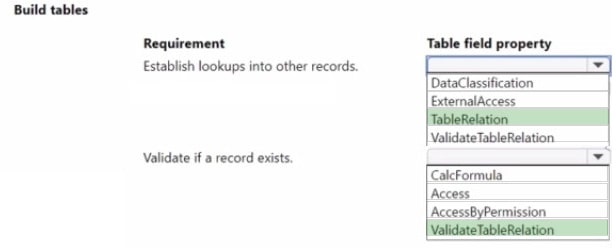
For the data integrity requirements, the table field properties to use are:
To establish lookups into other records, use the TableRelation property. To validate if a record exists in a destination record, use the ValidateTableRelation property.
In Business Central, when creating tables to hold data, maintaining data integrity is crucial:
TableRelation Property:This property is used to create a relationship between the field in one table and a field in another table, which is typically used for lookups. When you set the TableRelation property on a field, it allows users to select
from a list of values that exist in the related table.
ValidateTableRelation Property:This property is used to ensure that the value entered in a field matches one of the values in a related table. If a user tries to enter a value that doesn\’t exist in the related table, an error will occur.
Above, I’ve shared some of the latest MB-820 exam materials practice questions for free. If you’re still craving more, you’re welcome to download 113 truly useful exam preparation materials at https://www.leads4pass.com/mb-820.html to help you identify any gaps after the latest changes to the MB-820 exam: Dynamics 365 Business Central Developer Associate.

Related Posts
![[Aug 2025] Leads4Pass MB-335 exam materials updates and important Q&A](https://examdumpsbase.com/wp-content/uploads/2025/01/MB-335-q14-1.jpg)
[Aug 2025] Leads4Pass MB-335 exam materials updates and important Q&A